MCA Verify user guide: underwriting a deal step by step
MCA Verify is underwriting software for merchant cash advance funders. It reads bank statements, scores the deal, verifies the business exists, and records the decision with an audit trail. This guide walks the whole path a deal takes through the platform, screen by screen.
Last updated 14 September 2026. The screenshots are re-checked against the live product every week.
Every screenshot below is the live product. If you want to follow along in your own account, sign in at app.mcaverify.com and work a test deal alongside the guide.
What is MCA Verify?
MCA Verify is a web-based underwriting platform for MCA funders and the ISOs who submit to them. It automates bank-statement analysis, detects existing advances and possible statement tampering, produces an explainable risk score and a draft credit memo, and keeps an immutable record of every decision for compliance review. For how it compares with the alternatives, see our roundup of the best MCA underwriting tools and what software MCA funders use.
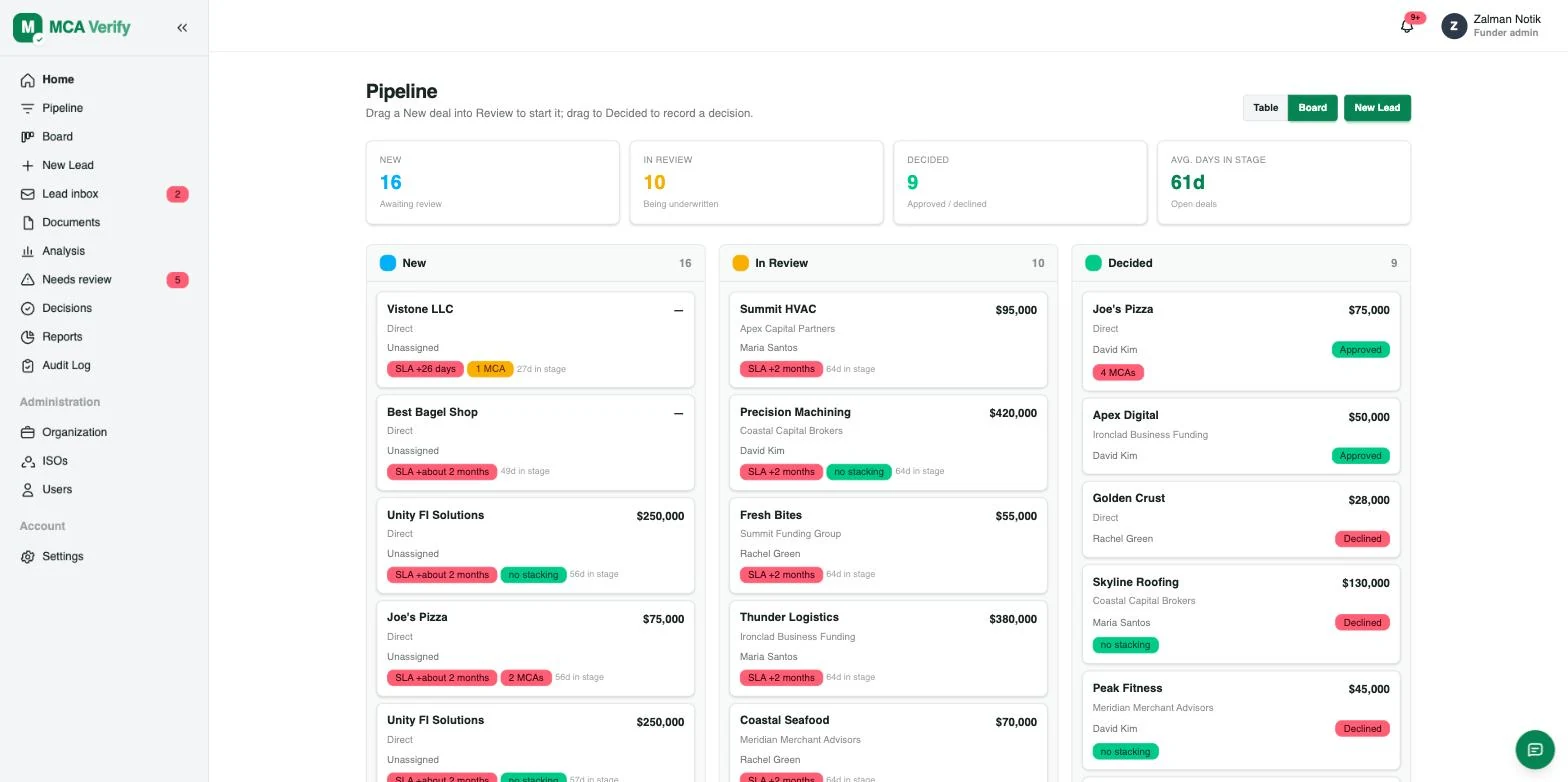
Work is organised around one object — the deal — which moves through three stages:
- New — submitted, awaiting review
- In Review — being underwritten
- Decided — approved, approved with conditions, or declined
How does a deal get into MCA Verify?
There are three intake routes: forward the broker’s submission email to your private intake address and the platform reads the email and its attachments into a prefilled lead; key the deal in manually on the New Lead form; or upload the documents first and let the platform build the deal from what it reads in them.
1. Forward the submission email
Each funder organisation gets a private intake address. Forward the submission with its attachments and it lands in the Lead inbox, parsed and ready to review. Replying on a deal’s own intake thread appends the new documents to that deal instead of opening a duplicate.


2. Key it in
The New Lead form takes the requested amount, ISO, underwriter and purpose, then the business block. Only the business name is needed to start — the rest can be auto-filled later from the signed application.

3. Start from the documents
If all you have is a pile of PDFs, Start from documents reads them and builds the deal record from the application, statements and ID it finds.
What does the underwriting workflow look like?
Each deal carries a six-step checklist: business and owner details, bank financials, identity documents, business verification, AI deal summary, and decision. The steps are a recommended order rather than a gate — an underwriter can work them in any sequence, and the deal page highlights the next one worth doing.

- Business & owner details — legal name, DBA, FEIN, NAICS, address, owners and ownership percentages.
- Bank financials — upload statements for analysis, or send the merchant a secure bank-connection link.
- Identity documents — driver’s licence, voided check and signed application, cross-checked against the deal data.
- Business verification — an open-web check that the business, address, phone and owner are real.
- AI deal summary — a verdict with the findings behind it, plus a draft credit memo.
- Decision — approve, approve with conditions, decline, or return for information.

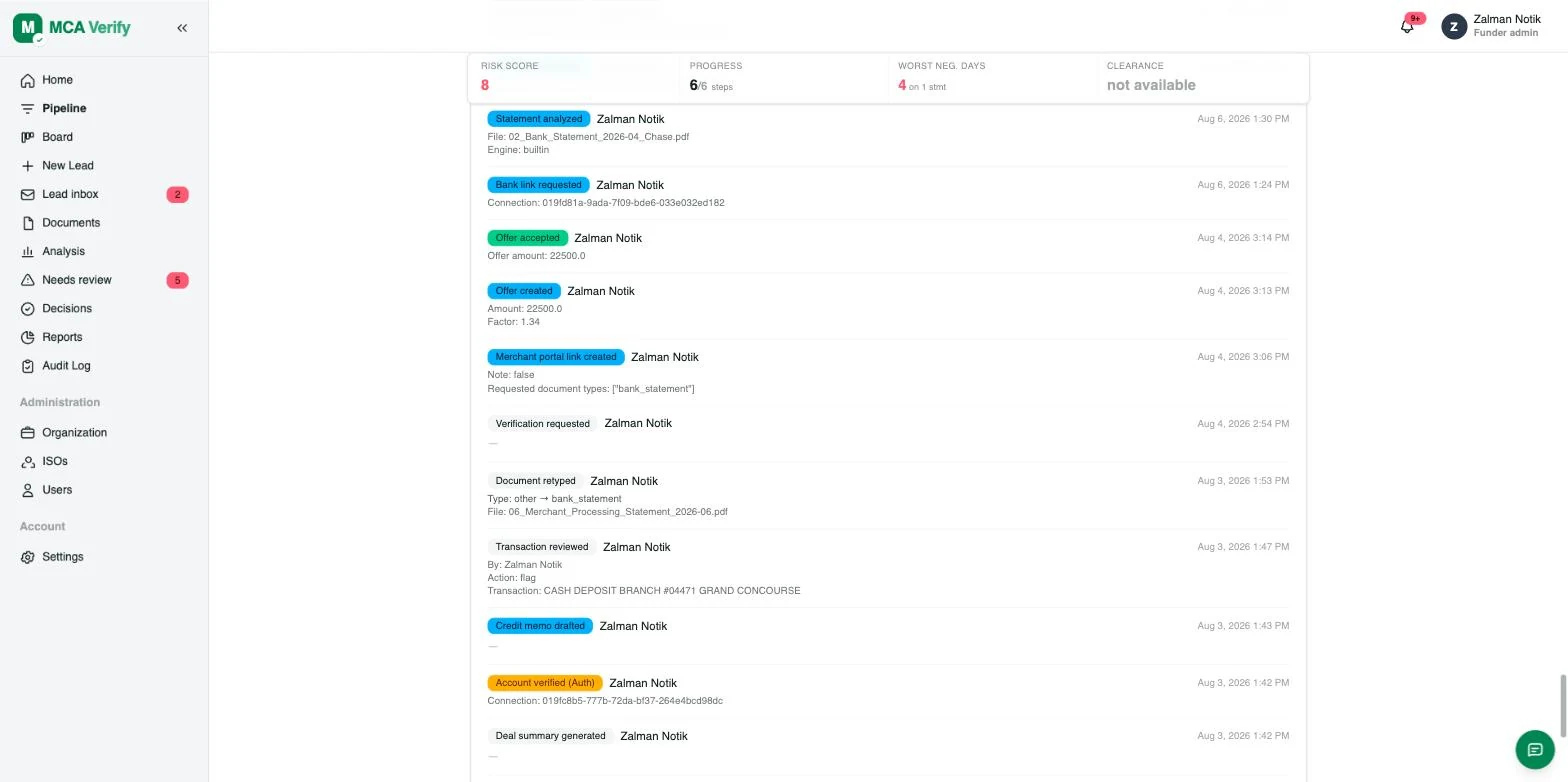
Four figures stay pinned at the top of the deal as you scroll: the risk score, progress through the six steps, the worst negative-day count on any single statement, and payment clearance.
How do you collect documents from a merchant?
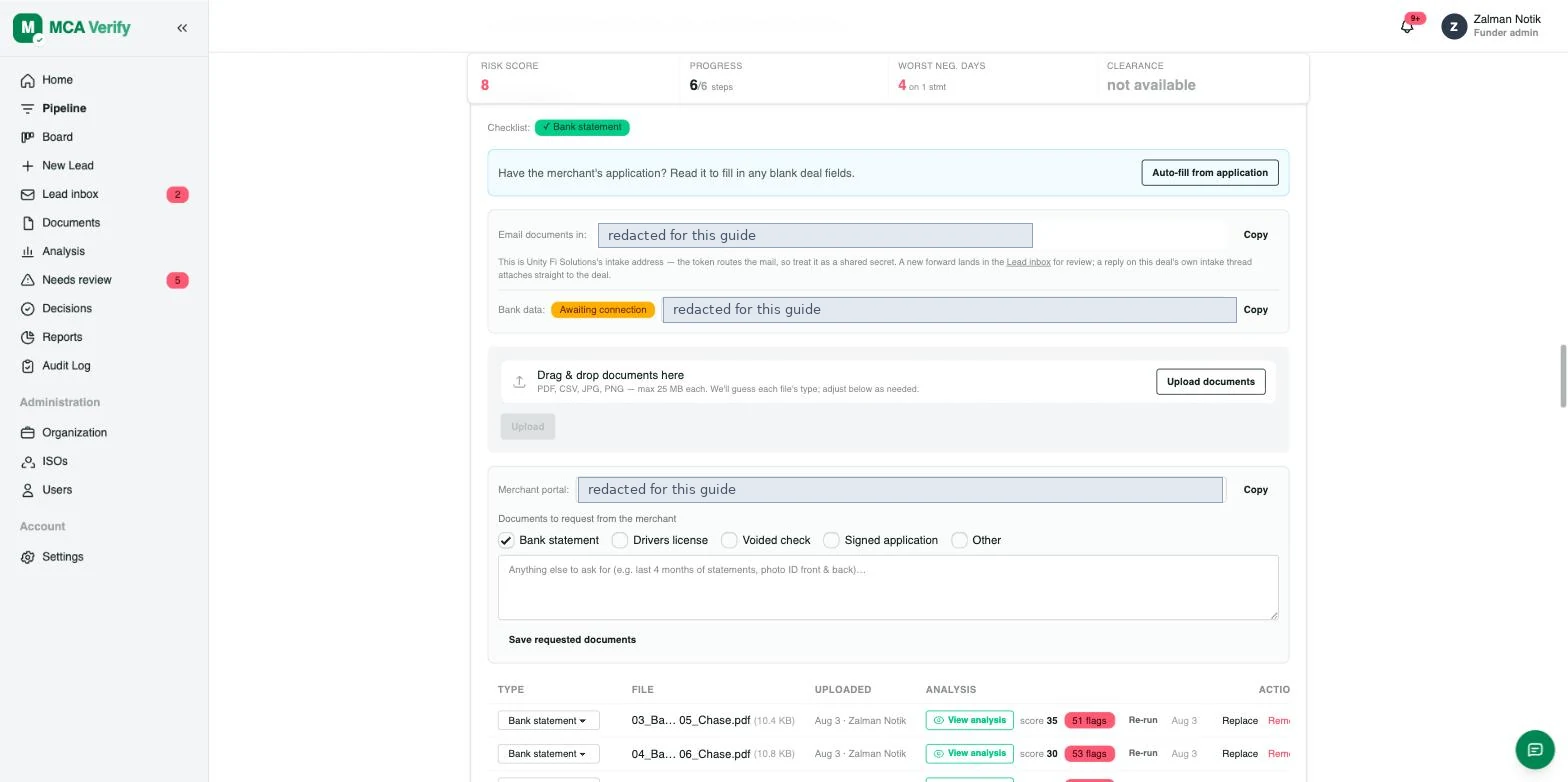
Four ways, all from the deal’s Documents panel: drag and drop files yourself, forward them to the deal’s own email address, request a secure bank connection, or send the merchant a portal link. Documents that arrive by any route are typed automatically and queued for analysis.


How does bank statement analysis work?
Every statement is parsed into transactions and scored out of 100. The analysis extracts the header values (institution, account, period, opening and closing balance), derives true revenue, deposits, average and minimum daily balance, negative days and NSFs, and flags transactions that look like advance repayments.

Corrections are part of the workflow, not an exception to it. Every extracted line sits beside the source PDF: confirm it, dismiss a flag as a false positive, mark a debit as an MCA, or rule a deposit in or out of revenue. Fix a value and the metrics and score recalculate; the model’s original reading is kept alongside yours.


How do you spot MCA stacking in bank statements?
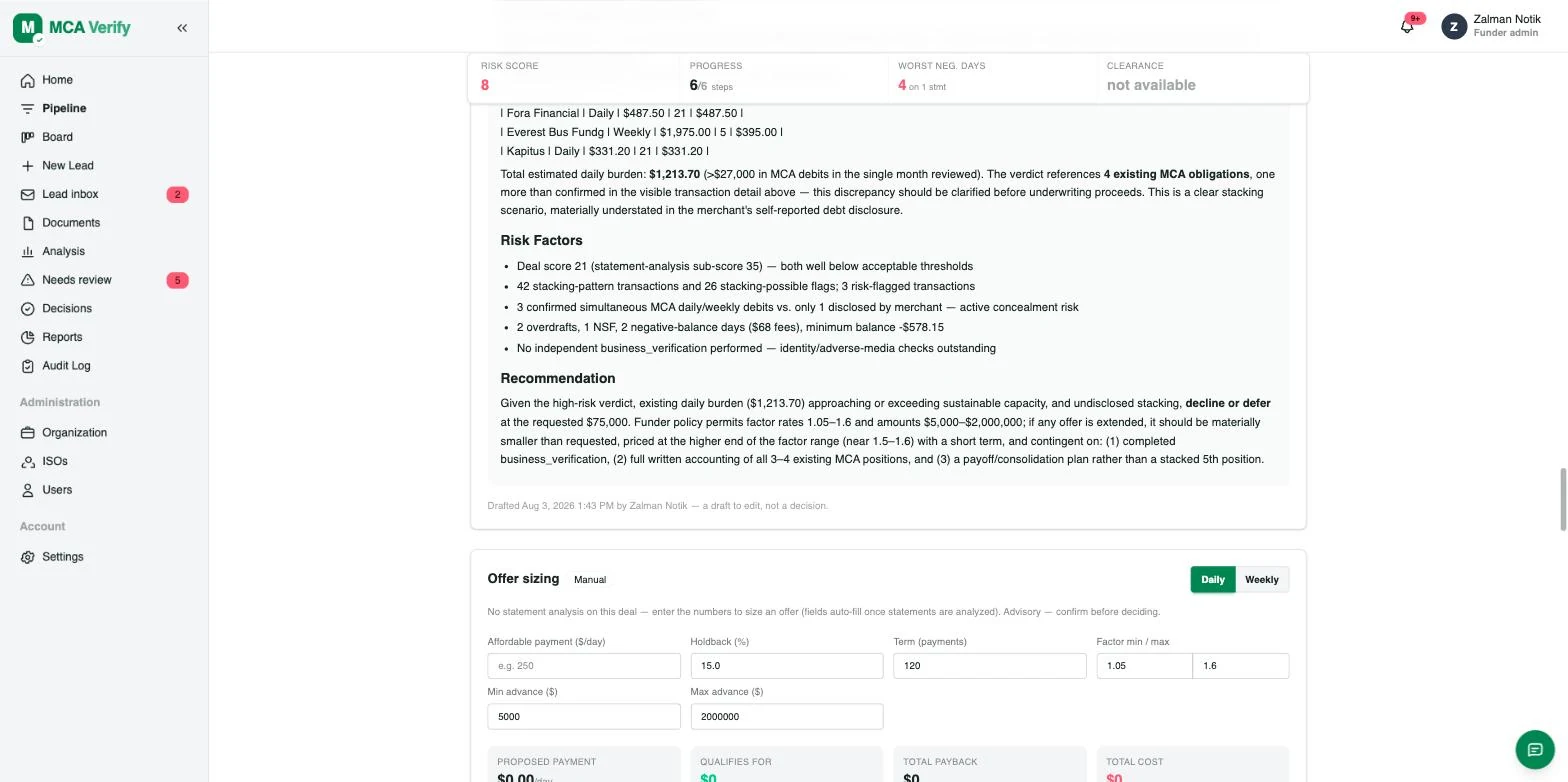
Stacking shows up as repeating daily or weekly debits to funder descriptors. MCA Verify groups those debits into obligations — funder name, frequency, number of payments seen, average payment and estimated daily burden — then compares the total against the headroom available at your holdback rate.

The gap that matters is between what the merchant disclosed and what the statements show. A deal that discloses one advance while the bank activity shows three simultaneous positions is telling you something before any score is calculated.
How do funders detect doctored or altered bank statements?
Three checks run together: whether the statement’s own math reconciles, whether each statement’s closing balance matches the next one’s opening balance, and whether the document itself shows signs of editing or self-identifies as a sample. Anything that fails lands in a review queue rather than passing silently.
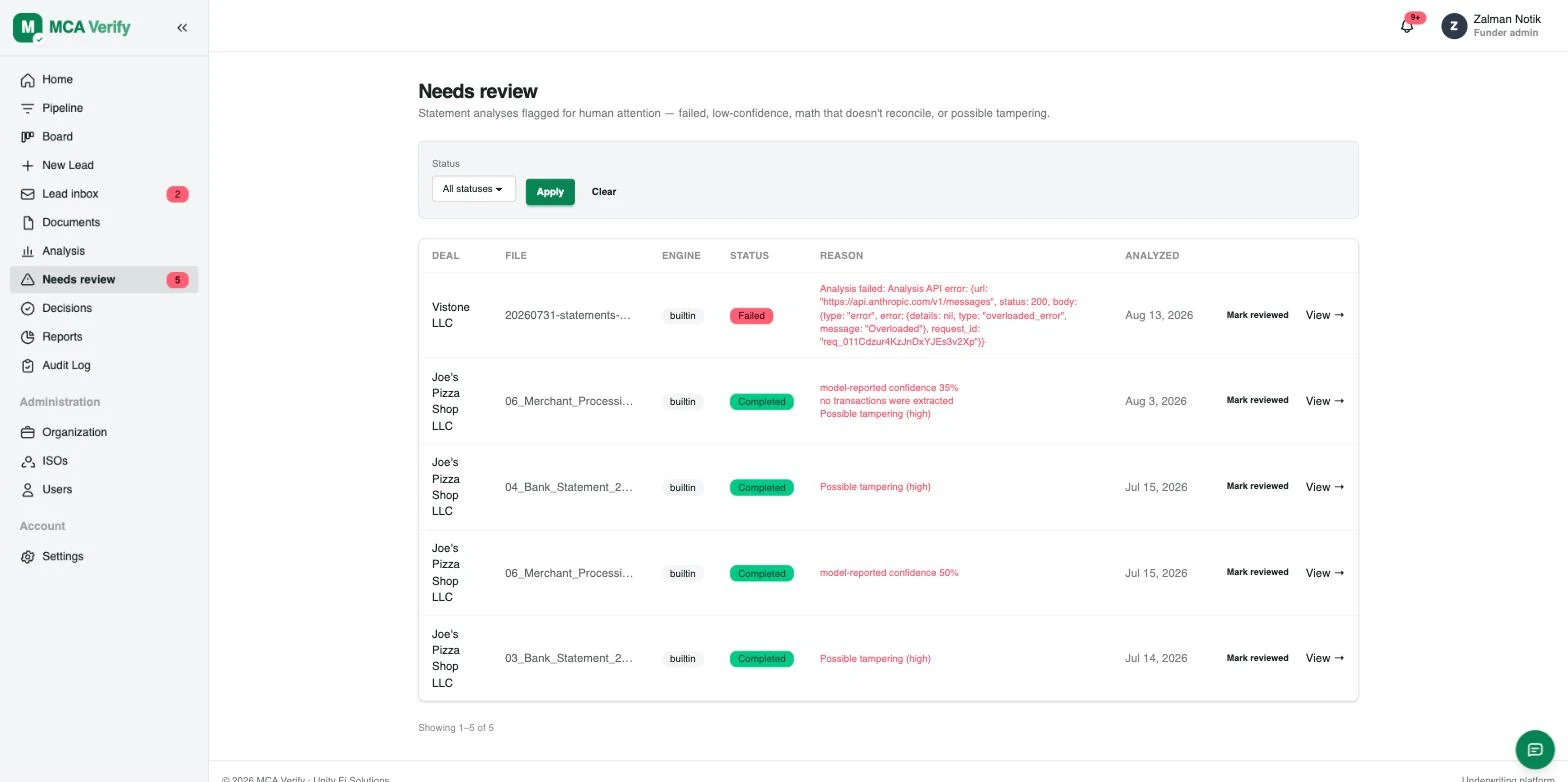
For a deeper treatment of the red flags themselves, see how lenders detect doctored or altered bank statements.
How is an MCA risk score calculated?
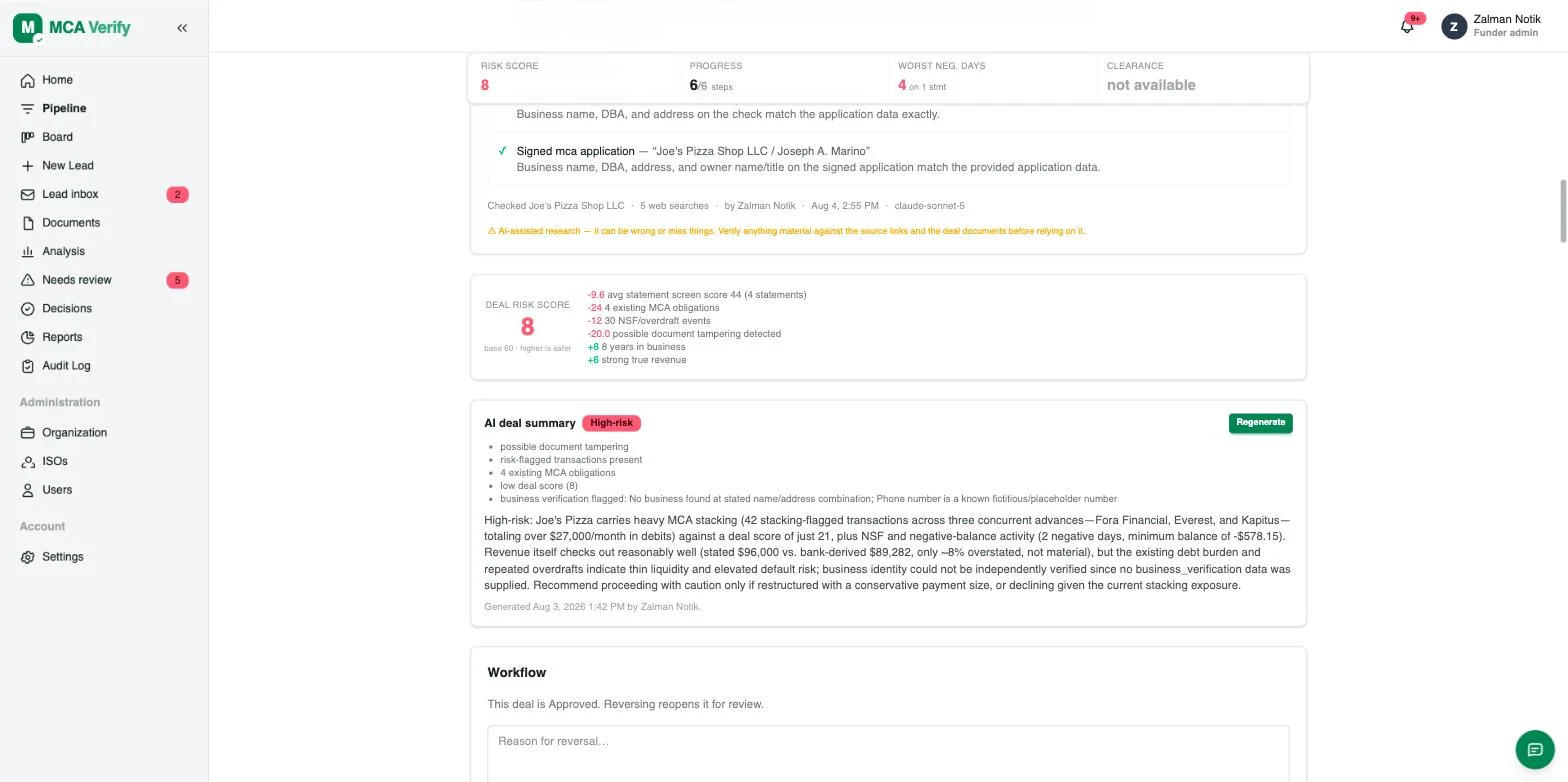
The deal risk score starts at a base of 60 and moves up or down with what the analysis found — higher is safer. Every adjustment is itemised on the deal, so the number is explainable to a credit committee rather than a black box. Statement screen scores are separate, one per document, also out of 100. For the concept rather than the software, see what a merchant cash advance risk score is.
| Factor on this deal | Effect on score |
|---|---|
| Average statement screen score 44 across 4 statements | −9.6 |
| 4 existing MCA obligations | −24 |
| 30 NSF / overdraft events | −12 |
| Possible document tampering detected | −20 |
| 8 years in business | +8 |
| Strong true revenue | +6 |
How do you verify the business actually exists?
Business verification searches the open web for the entity, its address, phone, website, owner, industry, reviews, lawsuits and adverse media, then cross-checks what it finds against the documents on file. Each finding carries a category, a confidence level and the source links behind it.
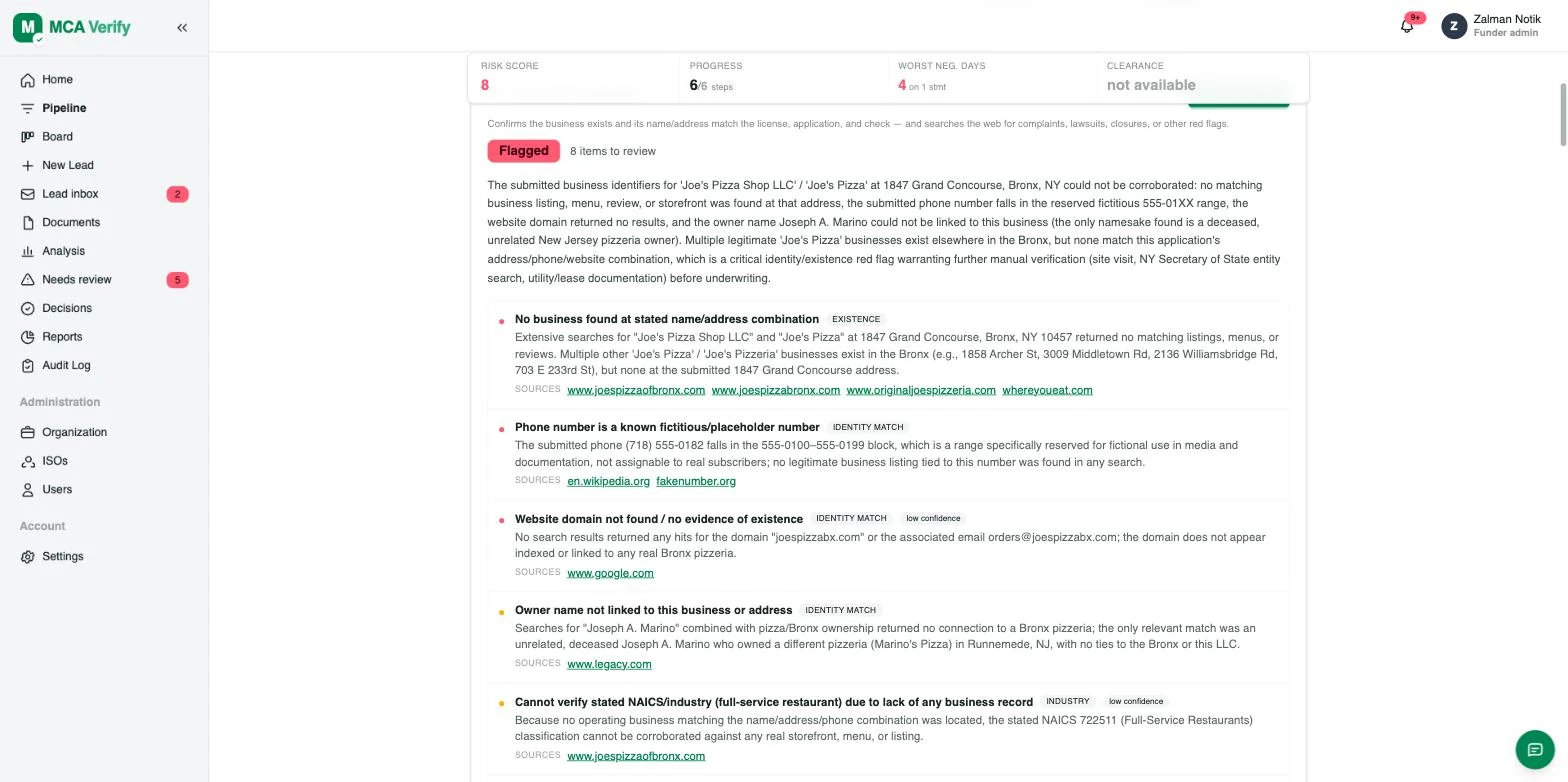
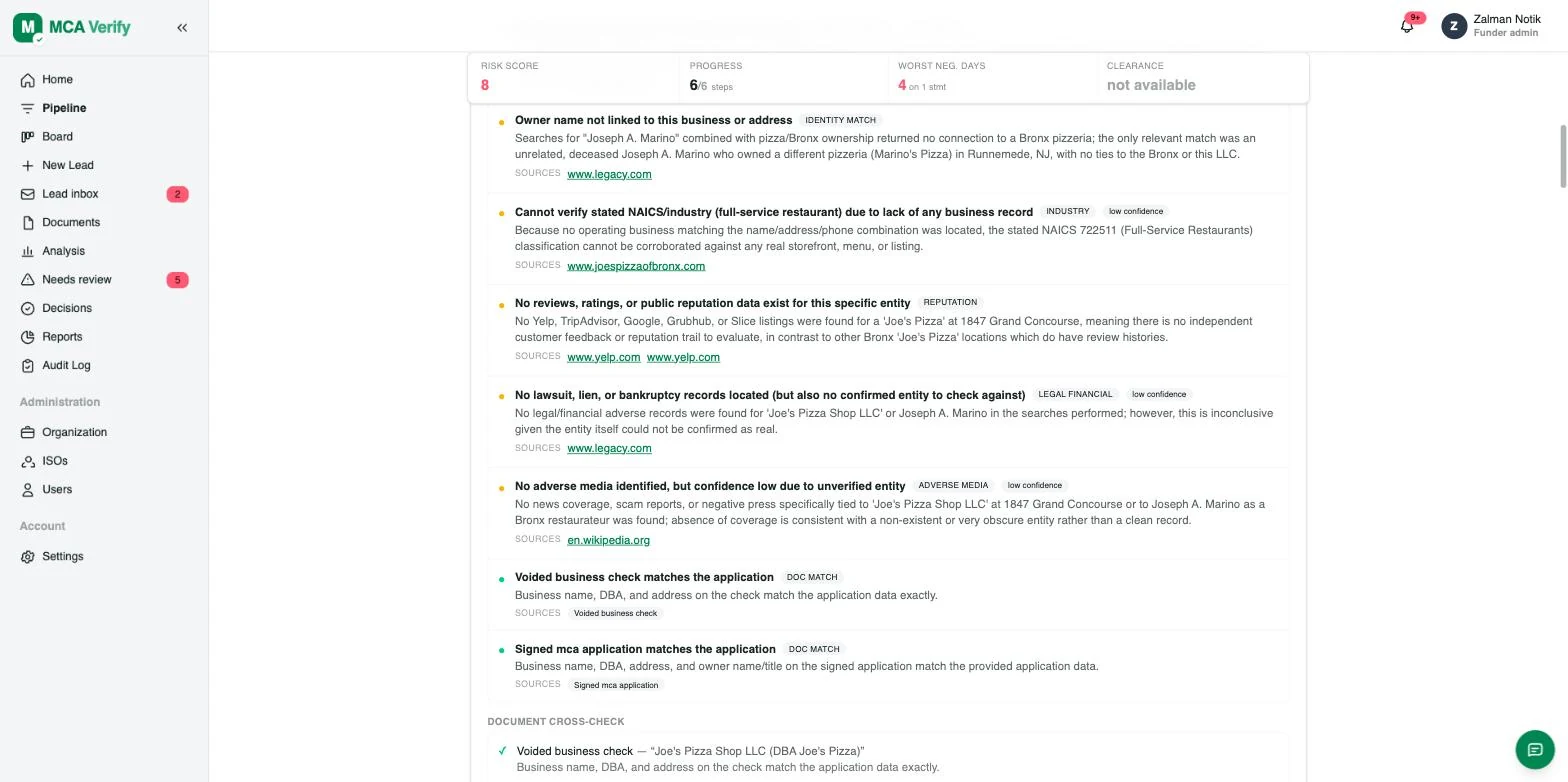
Two findings that consistently matter: a phone number in a reserved fictitious range, and a business name and address combination that returns no listing, menu, review or storefront anywhere.
What goes into the credit memo?
The credit memo is generated from the deal’s own data — verdict, merchant overview, cash-flow analysis, stacking picture, risk factors and a recommendation framed against your funder policy. It is produced as a draft for the underwriter to edit, not as a decision.

How do you size an offer against real cash flow?
Offer sizing turns the analysis into terms. Enter an affordable payment or let it fill from the statement analysis, set holdback, term and factor bounds, and the platform computes the proposed payment, the amount the deal qualifies for, total payback and total cost — then simulates the payment against historical balances.

Read clearance conservatively. It measures against balances that already absorbed whatever the merchant was paying at the time, so it shows headroom on top of existing obligations rather than total capacity.
How is the decision recorded and audited?
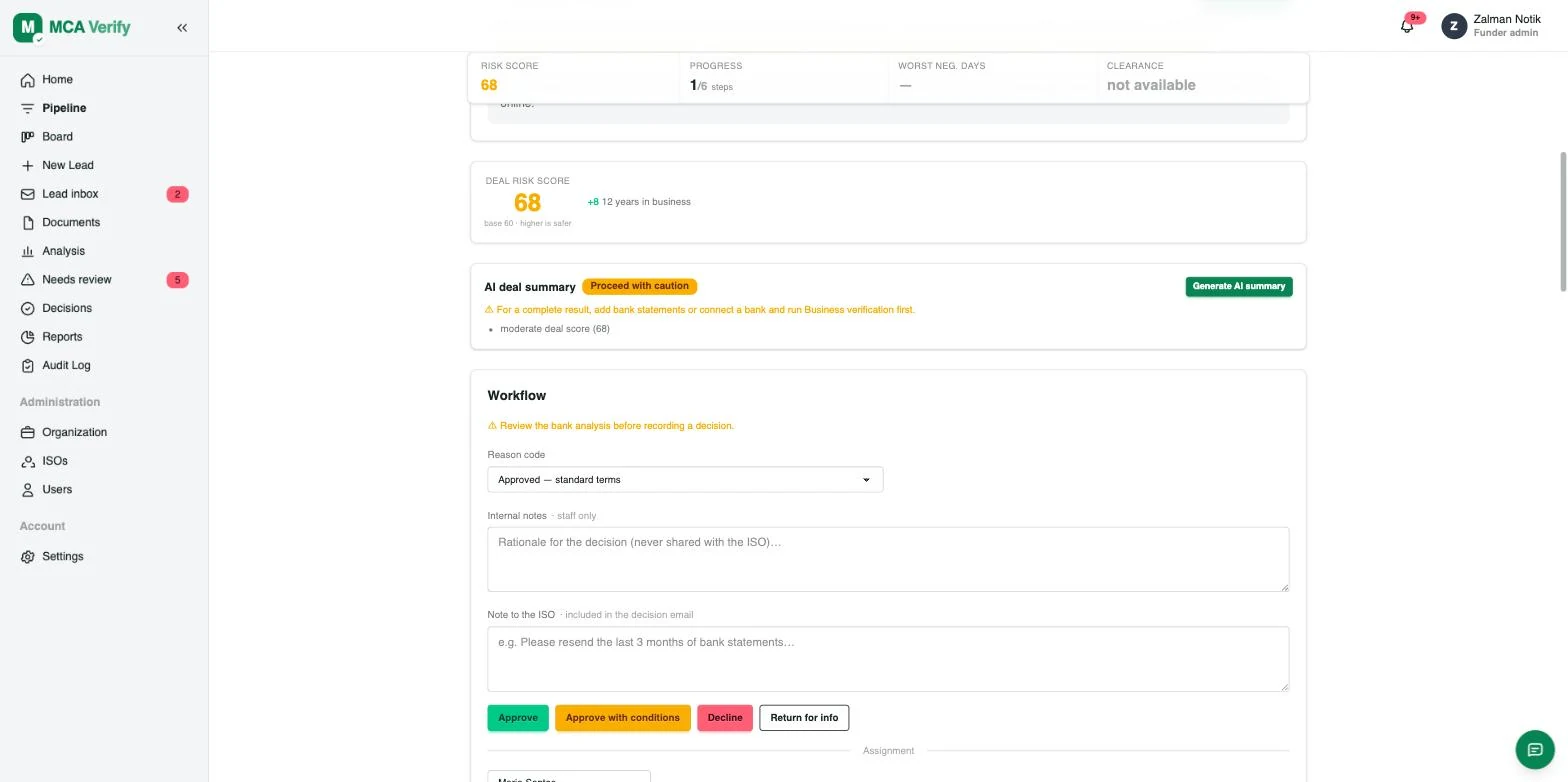
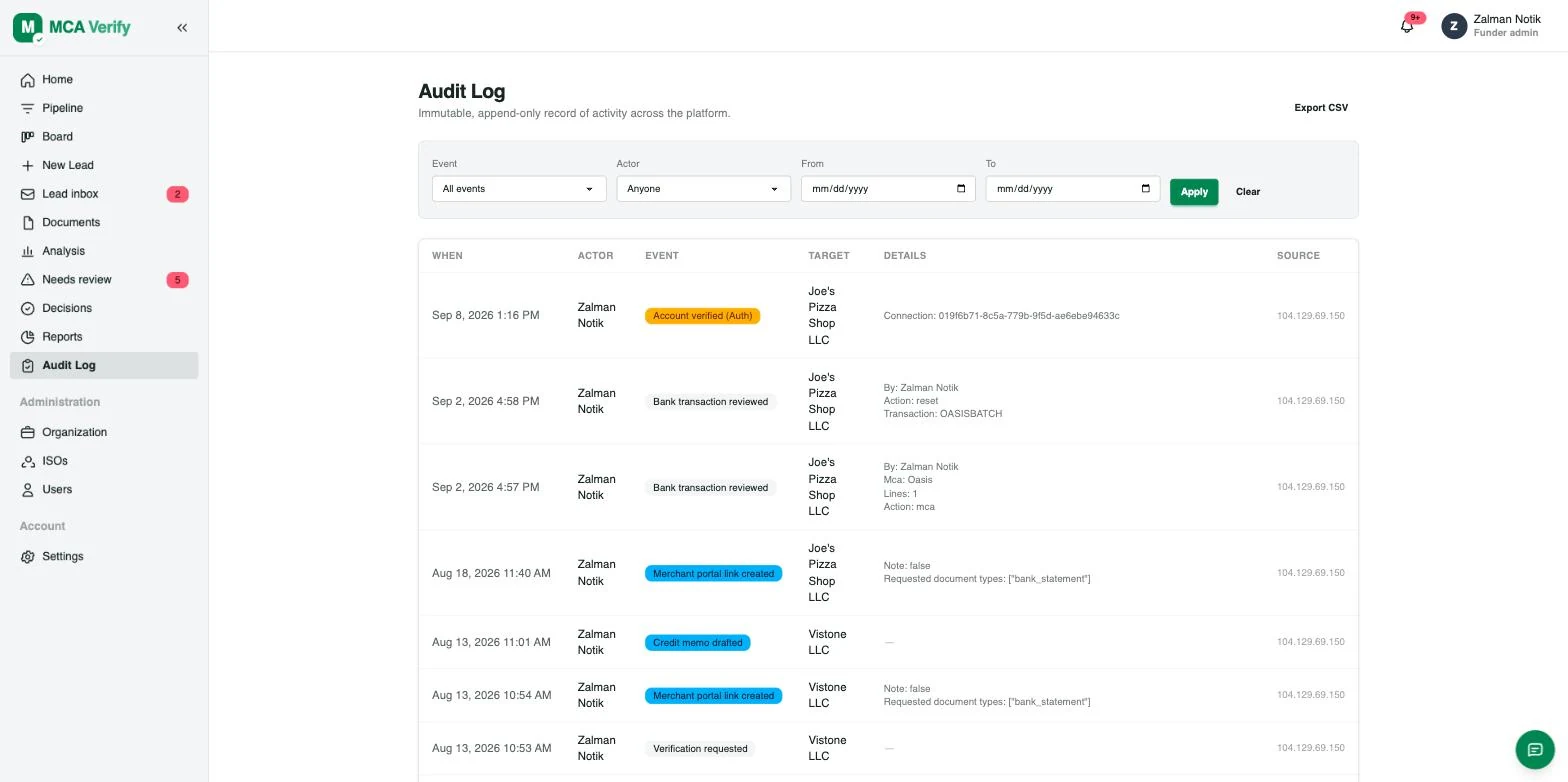
Decisions are made from the deal’s workflow panel with a reason code, internal notes that stay internal, and a note to the ISO that goes out with the decision. Approving with conditions requires at least one stipulation on the deal. Every decision is written to an immutable history.
What else is in the platform?
Beyond the deal itself, MCA Verify keeps the book-level views a funding operation runs on.

- Documents — every file across the book with its type, source and analysis score.
- Needs review — the queue of analyses flagged for human attention.
- Decisions — the decision log across every deal, exportable.
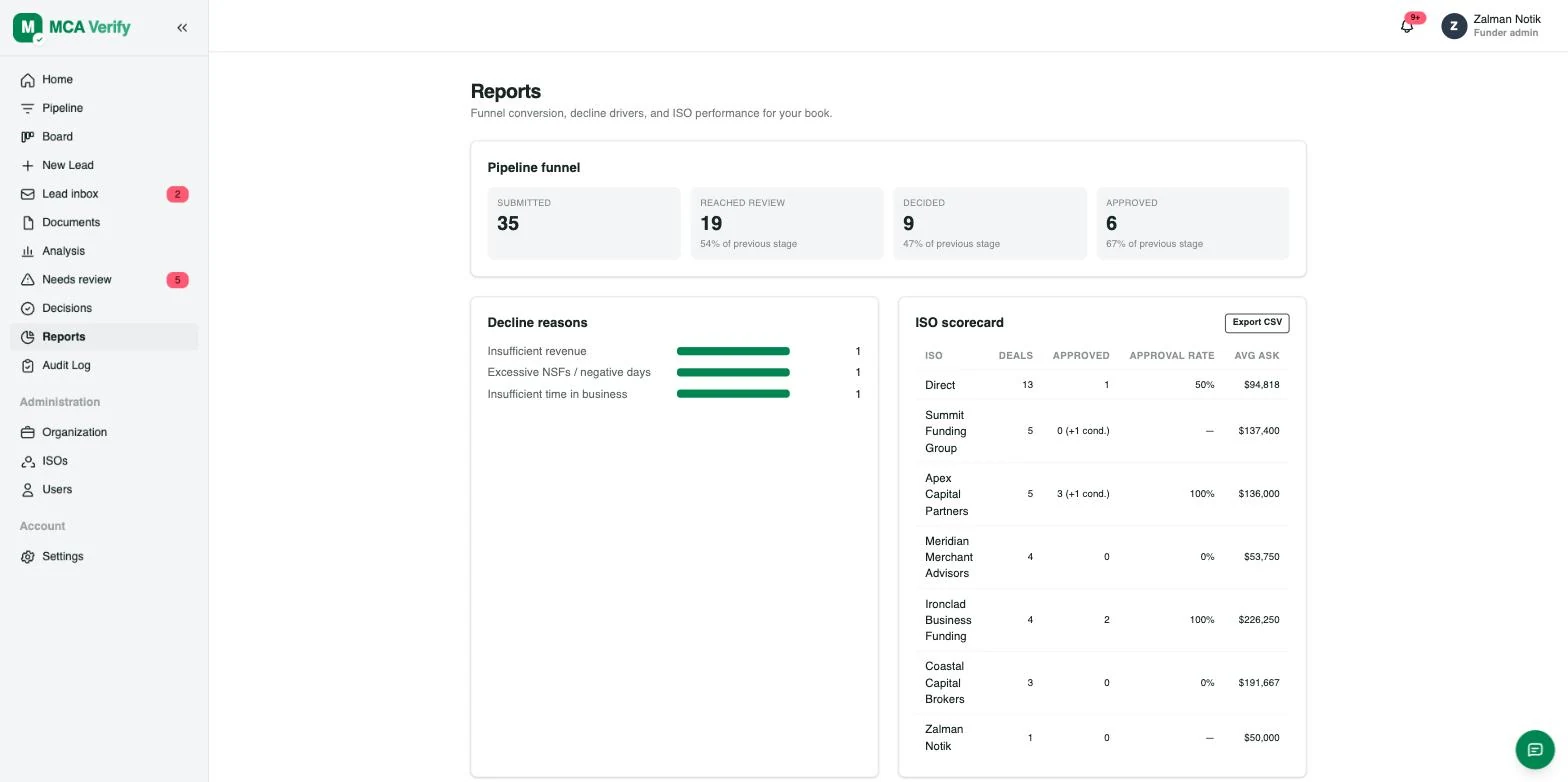
- ISOs — the brokers who submit to you, with submission emails and performance in the scorecard.
- Users — roles for funder admin, underwriting manager, underwriter and compliance.
Frequently asked questions
Do I need to upload bank statements, or can the merchant connect their bank?
Either. Uploaded PDFs are parsed and scored; a bank connection returns live balances and transactions through a secure link the merchant opens themselves. Most files use both, because the connection is what corroborates the PDFs.
How many months of statements does MCA Verify need?
It analyses whatever is provided, statement by statement, and rolls the results into deal-level metrics. Most funders work from three to four consecutive months, which is also what makes the continuity check between closing and opening balances meaningful.
Can underwriters correct what the analysis extracted?
Yes. Every extracted value and every flagged transaction can be corrected, dismissed or re-categorised, and the metrics and score update accordingly. The model’s original values are retained alongside the corrections.
Does MCA Verify make the funding decision?
No. It scores, flags and drafts — the underwriter decides. The AI summary and credit memo are explicitly labelled as drafts, and business verification shows its sources so findings can be checked.
Can ISOs submit deals directly?
Yes. Each funder has an intake address that accepts forwarded submissions with attachments, and deals are attributed to the submitting ISO for the scorecard.
Does it integrate with our CRM?
MCA Verify runs alongside CRM and servicing systems, and the underwriting result can feed an internal loan or servicing platform through its API rather than replacing it. Tell us your stack on a demo call and we will walk through the fit.
Want to see it against your own files? Bring a recent declined deal to a demo — the statement analysis is the fastest way to judge whether the platform earns its place in your process. Still comparing options? Start with how funders speed up underwriting.